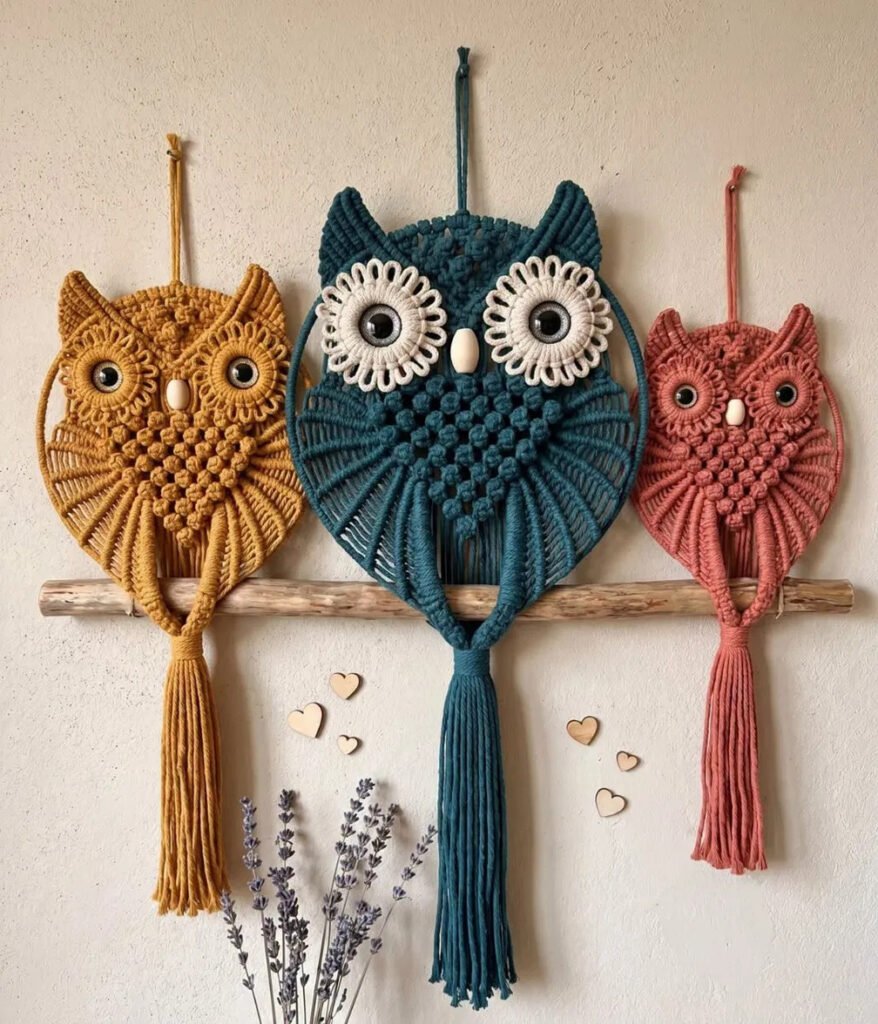
Three macramé owls in teal, mustard, and dusty rose mounted on a driftwood branch, showing the finished owl family trio macramé pattern.

Owl Hanging 3

Skill levelIntermediateFinished size26 in W x 30 in L (66 x 76 cm)Build time14-18 hours / 5 evening sessions

This owl family trio macramé pattern brings three charming owls—each perched in its own ring and adorned with picot-loop eye halos, safety eyes, and beak beads—together on a single driftwood branch. With teal, mustard, and dusty-rose cotton cords, staggered heights, and brushed tassels, the trio creates a playful yet elegant wall hanging. Because all three share the same anatomy scaled to different ring sizes, you can work them in parallel and master one set of techniques that repeats across the family.

Master the Owl Family Trio Macramé Pattern in About 14–18 Hours

Intermediate knotters will enjoy this project, which typically takes 14 to 18 hours spread across five relaxed evening sessions. The pattern includes lark’s-head mounting, berry-knot chest diamonds, picot square-knot eye rosettes, and sunburst double-half-hitch fans radiating onto bare ring arcs. In addition, the download provides a full illustrated step-by-step PDF with cord-cutting charts, knot diagrams, and troubleshooting tips, plus a printable quick-reference card to keep your place as you work.

Start by mounting 24, 20, and 16 cords respectively across the top arcs of a 12-inch, 10-inch, and 8-inch ring, leaving the lower curves bare for the fans. Next, build dense berry-knot foreheads and pointed ear tufts at each top corner. Then tie the signature picot rosettes—cream halos around the teal owl’s eyes, self-colored on the mustard and rose owls—and lock the safety eyes through the centers. Meanwhile, work the chest berry diamonds (21, 14, or 8 berries depending on size) and radiate double-half-hitch spokes down both sides to meet at six o’clock.

Perch Your Finished Owls on a Driftwood Branch

Once all three bodies are complete, gather each tassel with a wrap and tie the hanging loops to your branch at 5, 12, and 20 inches from the left end. Because the teal owl hangs slightly lower, the heads stagger in a pleasing composition. Finally, trim the tassels to graduated lengths, brush the bottom two inches, and enjoy your whimsical owl family watching over your favorite room.

Materials at a glance

  • 3 mm single-strand cotton cord in teal, mustard, dusty rose, and cream
  • Metal or wooden rings: 12 in, 10 in, 8 in diameter
  • Safety eyes: 20 mm, 16 mm, 14 mm (dark amber/black)
  • Oval wooden beads (beaks): 25 mm, 20 mm, 18 mm
  • Driftwood branch 24–28 in long, 1–1.5 in thick
  • Sharp shears, tape measure, fabric glue, wire pet brush, tapestry needle, painter's tape

Build order

  1. Prep rings, tie hanging loops, mark top-centers
  2. Mount body cords across each ring's top arc
  3. Head weave + ear tufts (all three owls)
  4. Eye rosettes, safety eyes, and beak beads
  5. Chest berry diamonds
  6. Sunburst side fans onto the bare ring arcs
  7. Gathering wraps + tassels
  8. Branch assembly, trim, brush, finishing

Cord cutting reference

  • A — 24 × 10 ft (teal owl body, 12 in ring)
  • B — 20 × 9 ft (mustard owl body, 10 in ring)
  • C — 16 × 8 ft (rose owl body, 8 in ring)
  • D — 4 × 6 ft (teal owl eye rosettes, cream)
  • E — 4 × 5 ft (mustard owl eye rosettes, mustard)
  • F — 4 × 4 ft (rose owl eye rosettes, rose)
  • G — 3 × 2.5 ft (gathering wraps, match body color)
  • H — 3 × 2 ft (hanging loops, match body color)

Knot abbreviations

  • LH = Lark's Head
  • SK = Square Knot
  • PSK = Picot Square Knot
  • DHH = Double Half Hitch on Ring
  • BK = Berry Knot
  • GK = Gathering Knot

Top 5 mistakes to avoid

  1. Rosette puckers into a cone—too many picot square knots for the circle; remove one knot.
  2. Eyes sit at different heights—anchor rosettes at two points, hang the owl, measure, then finish all four anchors.
  3. Berry knots flatten or turn backward—pull fillers straight down behind, not sideways.
  4. Fan spokes bunch near the top—space hitches evenly; mark the ring arc in pencil first.
  5. Owl twists on its loop—hanging loop is off top-center; re-seat the lark's head to align with the beak line.